
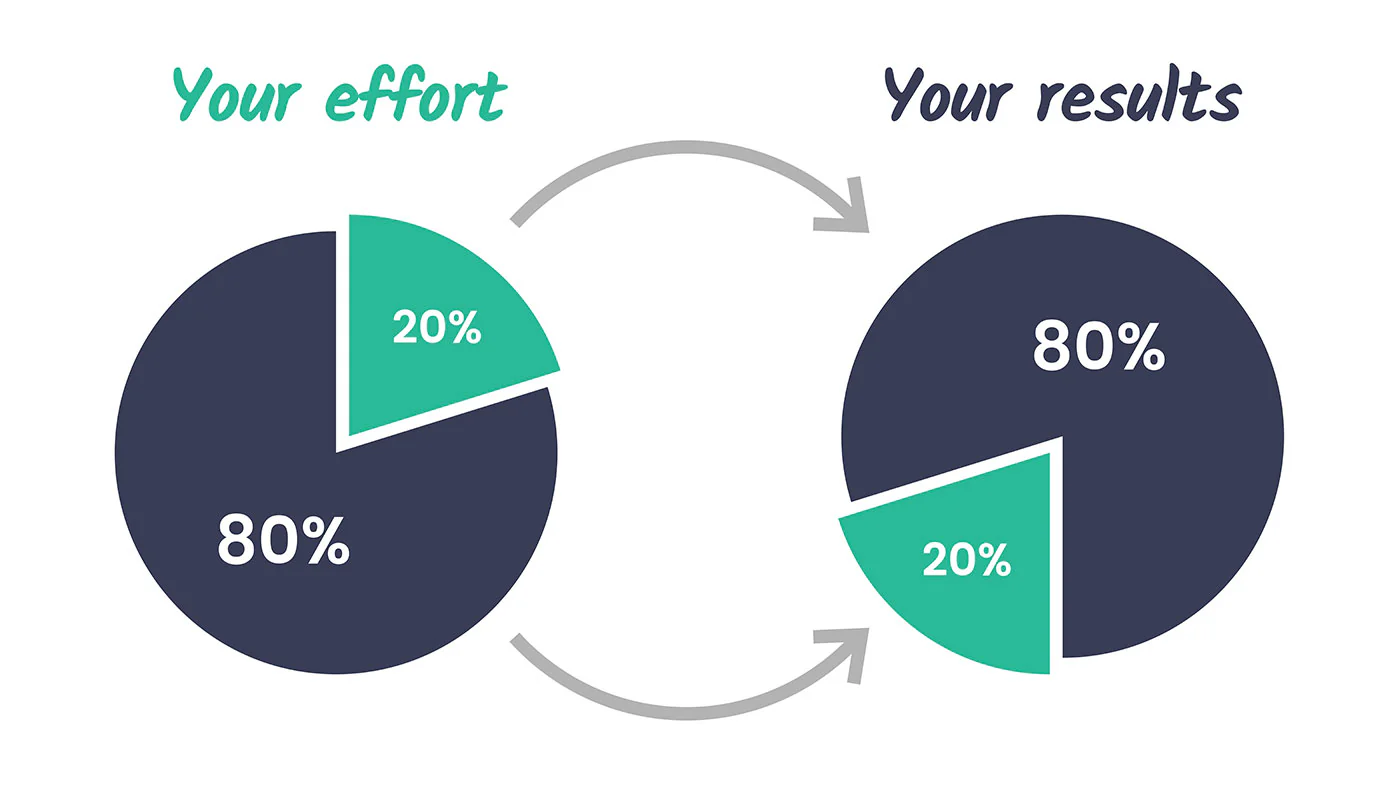
The Pareto Principle—commonly known as the 80/20 rule—states that roughly 20 percent of effort yields 80 percent of results. Applied to business English vocabulary, this principle reveals a powerful insight: just 500 carefully-selected words cover approximately 80% of all business communication. Moreover, the most frequently-used 50 core words cover 45% of communication, and 200 strategically-selected words cover 65-70%.
This means entrepreneurs and professionals can achieve functional business fluency not through exhaustive vocabulary memorization (which most language learners never complete) but through mastery of a focused, high-frequency word set combined with understanding how these words combine into phrases and collocations.
The 500 core business words comprise 305 business-specific terms (finance, operations, sales, strategy) and 195 general English words used frequently in business contexts. This guide identifies these 500 words, organizes them by frequency and business function, and provides a strategic 4-phase learning roadmap that progresses from 50-word foundation (Phase 1) through 500+ specialized vocabulary (Phase 4).
The 80/20 Principle Applied to Business English
What Does “80/20” Actually Mean in Language Learning?
The literal application doesn’t mean exactly 80% of communication comes from precisely 20% of vocabulary. Rather, it’s a principle demonstrating that disproportionate results come from focused effort on high-impact items.
More accurate representations:
- 100 most common words = ~50% of daily business conversations
- 500 core business words = ~80% of business communication
- 1,000 most frequent words = ~90% of formal business writing
- 2,000-3,000 words = ~95% of all conversations and written content
Why this matters for busy professionals: Rather than studying 10,000+ English words (the size of an average native speaker’s active vocabulary), entrepreneurs can achieve functional business communication competency by mastering 500 words—a 95% reduction in learning burden while capturing 80% of communication value.
The 500 Core Business English Words: Frequency Distribution
Word Type Breakdown
Research on business English corpora reveals clear patterns in word usage:
By part of speech:
- Nouns: 63.51% (business concepts: investment, sales, customer, strategy, market)
- Verbs: 8% (business actions: increase, analyze, develop, provide, manage)
- Adjectives: 7% (qualities: financial, annual, total, current, available)
- Adverbs: 2% (how things happen: annually, globally, significantly)
- Other (prepositions, articles): 19.49%
By collocational pattern (how words combine):
- Adjective + Noun: 40% (“financial data”, “strategic decision”, “quarterly revenue”)
- Noun + Noun: 35% (“budget planning”, “sales pipeline”, “market analysis”)
- Noun + Verb: 20% (“revenue increases”, “profit margins”, “customers demand”)
- Verb + Preposition + Noun: 5% (“focus on strategy”, “invest in growth”, “hire for culture”)
Critical insight: Rather than learning 500 isolated words, entrepreneurs should learn 150-200 core words and then learn which 2-3 other words commonly combine with each one. This “word chunking” approach accelerates fluency—a learner knowing “revenue,” “increase revenue,” and “revenue target” has learned three related concepts from one core word.
The Four-Phase Learning Roadmap
Phase 1: Foundation (2 Weeks) — Master the Essential 50 Words
Target: 45% communication coverage with 50 core words
The core 50 words (essential across ALL business contexts):
Finance (8 words): revenue, profit, budget, cost, investment, cash flow, capital, expense
Operations (8 words): process, timeline, deliver, quality, efficiency, resource, target, deadline
Sales (6 words): customer, client, sale, market, lead, close
People (5 words): team, employee, manager, hire, delegate
Strategy (8 words): goal, objective, strategy, growth, innovation, timeline, improvement, expand
Communication (4 words): meeting, discuss, feedback, decision
Action (3 words): implement, develop, improve
Week 1 daily practice (10 minutes):
- Monday-Wednesday: Learn 10-15 words using spaced repetition (Anki, Quizlet)
- Thursday-Friday: Write 3 email snippets using these words
- Weekend: Record yourself explaining a business concept using ONLY these 50 words
Expected outcome: Understand basic business conversations; write clear, simple emails; explain business concepts at elementary level (A2-B1 proficiency).
Phase 2: Expansion (4-6 Weeks) — Add 150 Medium-Frequency Words
Target: 65-70% communication coverage with 200 total words
Add these categories:
Finance (15 more): asset, equity, liability, ROI, margin, cash, invest, acquire, margin, dividend, interest, loan, payment, fiscal
Operations (15 more): workflow, allocate, optimize, streamline, implement, inventory, supply, procurement, maintenance, upgrade, installation, installation, capacity, utilization
Sales (15 more): pipeline, prospect, conversion, positioning, value proposition, competitive advantage, market share, penetration, contract, negotiation, objection, closing technique, account
People (10 more): talent, recruit, onboard, performance, culture, engagement, development, retention, compensation, interpersonal
Strategy (15 more): alignment, milestone, scope, initiative, execution, vision, mission, objective, transformation, pivot, scaling, competitive advantage, differentiation
Communication (10 more): clarification, agenda, action item, update, escalate, present, articulate, rapport, stakeholder, coordination
Technology (10 more): digital, automation, data, system, cloud, integration, analytics, tool, platform, infrastructure
Week schedule (15-20 minutes daily):
- Theme each day: Monday=Finance, Tuesday=Operations, Wednesday=Sales, Thursday=People/Strategy, Friday=Communication
- Active learning: Read one business article/email; extract new vocabulary; use in sentences
- Speaking practice: 5 min daily speaking about business using new words
- Writing: Compose longer emails incorporating new vocabulary
Expected outcome: Conduct professional business conversations; participate in complex meetings; write nuanced emails; achieve B1-B2 proficiency.
Phase 3: Integration (4 Weeks) — Master Collocations & Phrases
Target: 75-80% communication coverage through word combinations
Rather than learning additional isolated words, master how the 200 words combine into phrases business professionals actually use:
Finance collocations:
- “increase revenue”, “reduce costs”, “improve profit margins”, “strong cash flow”, “positive ROI”
Operations collocations:
- “streamline process”, “meet deadline”, “deliver quality”, “allocate resources”, “exceed targets”
Sales collocations:
- “close the deal”, “build pipeline”, “qualify leads”, “overcome objections”, “create value”
Communication collocations:
- “touch base”, “on the same page”, “circle back”, “align on”, “take offline”, “raise the bar”
Strategy collocations:
- “execute strategy”, “drive growth”, “manage risk”, “scale business”, “achieve alignment”
Learners completing Phase 3 can:
- Understand 75-80% of business conversations without looking up words
- Speak naturally about business topics with minimal pausing
- Write professional emails that sound authentic, not translated
- Participate confidently in meetings, negotiations, presentations
Expected outcome: B2-C1 proficiency; sound semi-native in business contexts; communicate nuanced ideas clearly.
Phase 4: Specialization (Ongoing) — Build Domain Expertise
Target: 80-95% communication coverage in your specific industry/role
Phase 4 vocabulary depends entirely on your industry, role, and business context. Examples:
Technology/Startup vocabulary:
- MVP (Minimum Viable Product), ARR (Annual Recurring Revenue), CAC (Customer Acquisition Cost), user acquisition, churn rate, runway, burn rate, Series A, pivot
Finance/Banking vocabulary:
- Derivatives, volatility, portfolio, hedge, liquidity, securities, bond, equity, fixed income, valuation
Healthcare vocabulary:
- Compliance, patient outcomes, EHR (Electronic Health Record), clinical trial, FDA approval, reimbursement, quality metrics
Manufacturing vocabulary:
- Supply chain, inventory management, Just-in-Time, quality control, yield, throughput, lean manufacturing
AI/Emerging vocabulary (2026):
- LLM (Large Language Model), fine-tuning, inference, prompt engineering, hallucination, tokenization, embedding
Strategy: Rather than memorizing these terms, immerse yourself in your domain:
- Read 2-3 industry articles weekly; capture new terms
- Listen to industry podcasts; note repeated vocabulary
- Attend industry events; observe how professionals use language
- Create domain-specific phrase book with collocations
Expected outcome: C1-C2 proficiency in your domain; thought leader credibility; ability to influence senior decisions through sophisticated language.
The Science: Why 80/20 Works
Three cognitive principles explain why focusing on 500 high-frequency words achieves disproportionate results:
1. Frequency effect: Brain naturally consolidates frequently-encountered words faster. The word “revenue” appears in ~95% of business documents; the word “synergy” appears in ~5%. Learners mastering high-frequency words get exponential return on study time.
2. Collocation memory: Rather than remembering 500 isolated words, remembering 150 words + their typical 2-3 combinations creates stronger neural pathways. “revenue increase” is easier to remember and use than “revenue” alone.
3. Contextual activation: Using learned words immediately in real business situations (emails, meetings, conversations) creates stronger encoding than study-only approaches. A learner using “alignment” in a real meeting locks that word into memory more effectively than any flashcard study.
Implementation Strategy: Avoiding the “Knowing vs Using” Gap
A critical failure point in language learning is the gap between “knowing” a word and “using” it fluently. Research on business professionals shows that many can recognize 1,000+ words but actively use only 200-300.
Strategies to close the knowing-using gap:
1. Immediate application
- Learn “revenue growth” on Monday
- Use it in an email or meeting by Wednesday
- The time compression between learning and use strengthens neural pathways
2. Deliberate output
- Rather than passively reading flashcards, speak and write with new vocabulary
- Record yourself explaining concepts using new words
- Write business scenarios using target vocabulary
3. Contextual learning
- Learn vocabulary through business articles, emails, meetings—not lists
- Place words in business scenarios relevant to your work
- Connect words to your actual business problems/opportunities
4. Spaced repetition + context
- See word in article (Monday)
- Use word in email (Wednesday)
- Hear word in podcast (Friday)
- Use word in meeting (next week)
- This varied context creates durable memory
The 500-Word List: Organized by Frequency & Function
The complete 500 words are organized into:
- Tier 1 (Top 1-10%): 50 absolutely essential words (revenue, profit, customer, team, goal, strategy, meeting, deadline, growth, feedback)
- Tier 2 (Top 11-30%): 100 high-frequency words (budget, market, process, timeline, employee, delegate, alignment, KPI, negotiate, implement)
- Tier 3 (Top 31-60%): 150 medium-frequency words (asset, equity, lead, prospect, scope, initiative, execution, innovation, culture, engagement)
- Tier 4 (Top 61-80%): 120 lower-frequency but still important words (contingency, stakeholder, governance, compliance, sustainability, benchmarking, diversification, acquisition)
- Tier 5 (Top 81-100%): 80 specialized/domain-specific words (depends on industry—examples: MVP, CAC, LLM, ESG, ARR)
Common Mistakes: Avoiding Pitfalls
Mistake 1: Jumping to Tier 3/4 before mastering Tier 1
- Learning “stakeholder governance alignment” before mastering “goal, strategy, meeting” creates weak foundations
- Solution: Complete Phase 1 (50 words) before moving to Phase 2
Mistake 2: Learning words in isolation without collocations
- Knowing “revenue” but not “increase revenue,” “revenue target,” “revenue growth” limits usefulness
- Solution: Always learn words with their typical 2-3 partners
Mistake 3: Not applying learned words immediately
- Studying vocabulary but never using it in real business contexts
- Solution: Set 48-hour deadline to use each new word in an email/meeting/conversation
Mistake 4: Trying to master 500 words simultaneously
- Cognitive overload; retention suffers
- Solution: Follow Phase progression: 50 words → 200 words → 350 words → 500+ words over 12-16 weeks
Mistake 5: Confusing “understanding” with “fluent use”
- Can recognize word in context ≠ Can use word naturally in conversation
- Solution: Use “output-focused” practice (speaking/writing), not just input (reading/listening)
Timeline to Business English Fluency Using 80/20
For non-native English speakers currently at B1-B2 level:
Weeks 1-2 (Phase 1): Master 50 core words
- Expected result: Can discuss basic business topics
Weeks 3-8 (Phase 2): Add 150 words, organize by theme
- Expected result: Can participate in professional meetings; write clear emails
Weeks 9-12 (Phase 3): Master collocations/phrases with Phase 1-2 words
- Expected result: Speak naturally; sound semi-native; communicate nuanced ideas
Weeks 13-16 (Phase 4): Build domain-specific vocabulary
- Expected result: Expert-level communication in your specific industry; thought leader credibility
Total time investment: 12-16 weeks of consistent study + daily application = functional business English fluency covering 80% of real business communication needs.
Conclusion: The Leverage of Strategic Vocabulary Mastery
The 80/20 Vocabulary Method challenges the conventional approach to language learning—which treats all words equally and requires mastering 5,000+ words for proficiency. Instead, it directs focus toward the 500 words covering 80% of business communication, then layers in specialized vocabulary based on specific industry/role needs.
The advantage is mathematical: A learner spending 100 hours achieving “mastery” of 500 high-frequency words achieves greater real-world communication ability than a learner spending 1,000 hours randomly studying from generic English materials.
For entrepreneurs and busy professionals, the 80/20 approach answers the practical question: “What’s the minimum vocabulary I need to communicate effectively in business?” The answer: Phase 1’s 50 core words for basic proficiency, Phase 2’s 200 words for professional fluency, and Phase 3’s mastery of collocations for native-like communication—all achievable in 8-12 weeks.
The path to business English mastery is not comprehensive vocabulary memorization. It’s strategic focus on high-frequency words, deliberate practice with collocations, and immediate application in real business contexts. This approach—the 80/20 method—delivers disproportionate results from proportionally minimal effort.