
English proficiency can help you stand out when applying for international positions, remote jobs, customer service roles, and opportunities with global companies. However, simply writing “English” on your CV is not always enough. Recruiters need to understand your level, your practical abilities, and how you use the language at work.
This guide explains how to describe your English skills professionally, choose the right proficiency level, highlight certifications, and optimize your LinkedIn profile with examples you can adapt to your experience.
1. Why English Skills Matter on Your CV
English is widely used in international business, technology, tourism, education, finance, and customer support. Employers may need people who can write emails, join video meetings, understand technical documentation, or communicate with clients in different countries.
Including your English proficiency can be particularly useful when applying for:
- Remote jobs: communicating with international teams through Slack, Zoom, Microsoft Teams, and email.
- Technology positions: reading documentation, discussing software requirements, and participating in code reviews.
- Customer service: answering questions and resolving problems for English-speaking customers.
- Sales and marketing: preparing proposals, managing accounts, and communicating with international clients.
- Tourism and hospitality: assisting visitors, handling reservations, and explaining services.
- Academic opportunities: applying for scholarships, postgraduate programs, and research positions.
2. How to Describe Your English Proficiency Level
The Common European Framework of Reference for Languages (CEFR) provides a widely recognized system for describing language proficiency. Its six levels range from A1 to C2.
| Level | Common description | What you can generally do |
|---|---|---|
| A1 | Beginner | Understand and use basic expressions and simple phrases. |
| A2 | Elementary | Handle familiar, routine exchanges and communicate simple information. |
| B1 | Intermediate | Manage many everyday situations and explain experiences in straightforward language. |
| B2 | Upper-intermediate | Communicate with reasonable fluency and participate in many professional discussions. |
| C1 | Advanced | Use English flexibly and effectively for complex professional and academic purposes. |
| C2 | Proficient | Understand almost everything heard or read and express nuanced meaning precisely. |
Use a level only when it accurately reflects your ability. A course completion certificate does not automatically prove a particular CEFR level, and self-assessments should be treated as estimates.
Which English level should you put on your CV?
Match your description to the job requirements and the tasks you can perform independently. These examples illustrate how to write it:
Basic English
English: Basic proficiency (A1–A2)
Suitable when you can use simple phrases but still need support for complex conversations.
Intermediate English
English: Intermediate (B1)
Useful when you can manage routine communication and explain familiar topics.
Upper-intermediate English
English: Upper-intermediate (B2)
Appropriate when you can participate in many work discussions and write clear professional messages.
Advanced English
English: Advanced (C1)
Use when you can handle complex discussions, detailed writing, and demanding professional tasks.
Is “fluent in English” better than a CEFR level?
Not necessarily. “Fluent” is familiar to recruiters, but it can mean different things to different people. A CEFR level gives a more standardized reference. If both descriptions are accurate, you can combine them, such as “English: Fluent, approximately C1 level,” making clear that the level is an estimate if you have not formally assessed it.
3. How to Add English Skills to Your CV
Most candidates can list English under a section called Languages, Language Skills, or Additional Skills. Place the section where recruiters can find it easily, especially if English is a requirement in the job advertisement.
Option A: Add a simple language section
LANGUAGES
Spanish: Native
English: Upper-intermediate (B2)
This format works well for most professional CVs. It is concise, readable, and easy for applicant tracking systems (ATS) to process.
Option B: Describe your practical English skills
If English is relevant to your target position, explain what you can do with it. Be specific about the tasks you have performed or can confidently handle.
LANGUAGE SKILLS
English: B2 (Upper-intermediate)
- Professional email and chat communication
- Participation in online meetings
- Reading technical documentation
- Preparation of reports and presentations
Keep only the abilities that genuinely describe you. If you have never prepared reports in English, do not include that item merely because it appears in a template.
Option C: Mention English in your professional summary
For jobs where English is a major requirement, mentioning it near the top of your CV can help recruiters recognize your suitability quickly.
Customer Support Specialist with three years of experience assisting customers, managing support tickets, and documenting solutions. English proficiency at B2 level, with experience communicating through email, chat, and online meetings.
Option D: Demonstrate English through work achievements
Your experience section can provide stronger evidence than a proficiency label alone. If you have used English at work, describe the context and result.
- Responded to customer inquiries in English through email and live chat.
- Collaborated with international colleagues during weekly project meetings.
- Prepared product documentation and user guides in English.
- Coordinated project updates with overseas clients across different time zones.
Where possible, add measurable results, but only when you can support the figures. For example, mention the number of customers supported or reports delivered if you have reliable records.
Where should English appear on a one-page CV?
If the position requires English, include it in the upper half of the document or in a clearly labeled skills section. If English is only a minor advantage, a short language section near the bottom may be sufficient. Avoid adding long descriptions that crowd out your relevant experience.
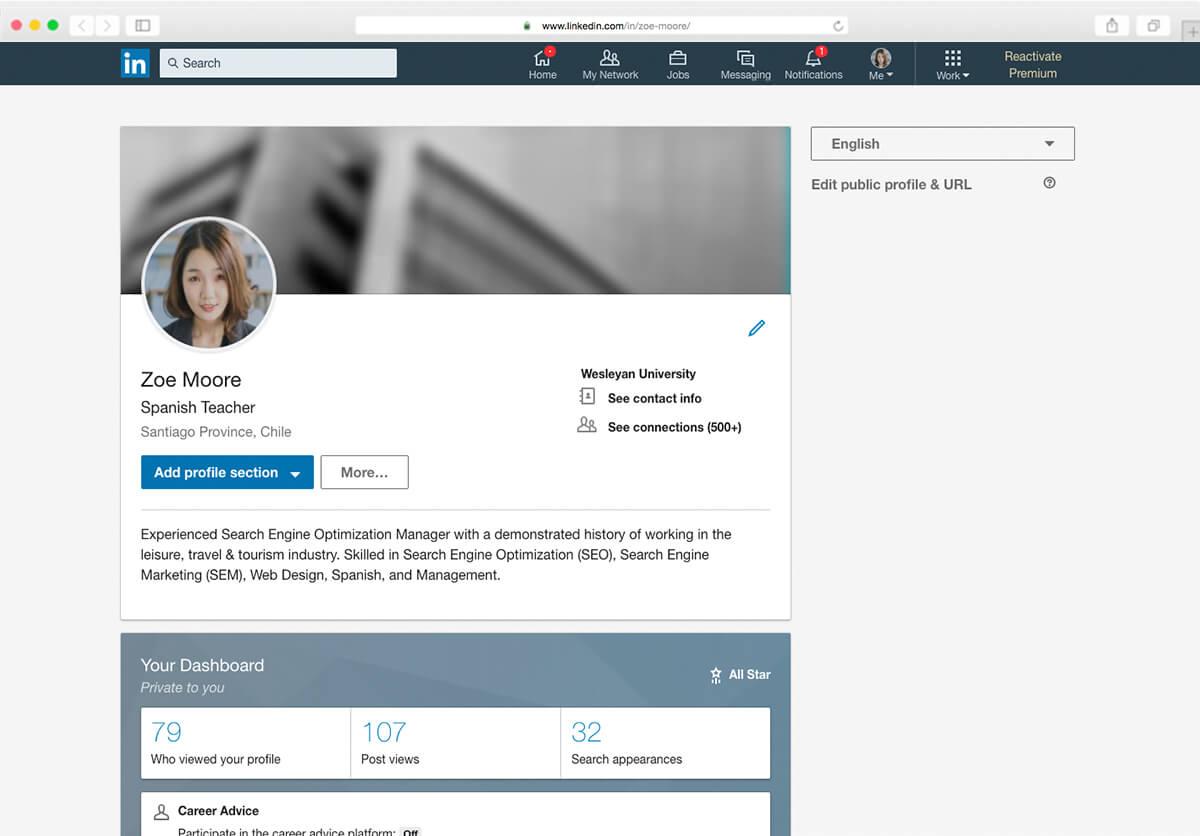
4. How to Add English to Your LinkedIn Profile
LinkedIn offers several ways to communicate your English proficiency. The most useful approach depends on whether you want to highlight a general ability, show a certification, or demonstrate professional experience.
Step 1: Add English to your Languages section
LinkedIn’s interface can change, but look for the option to add a profile section and then select the language-related section, if available. Choose English and select the proficiency description that most closely reflects your actual skills.
Available labels and menu locations may vary by account, device, and interface version. If you cannot find a dedicated language section, use your About, Skills, or relevant Experience section instead.
Step 2: Improve your About section
Your About section should explain what you do, the value you offer, and how you work. If English supports your professional goals, add one clear sentence about your communication abilities.
I am a digital marketing professional with experience in content strategy, SEO, and performance analysis. I communicate in English at an upper-intermediate (B2) level and can collaborate with international teams, write professional emails, and participate in online meetings.

I am interested in opportunities where I can contribute to cross-functional projects, improve digital performance, and continue developing my professional skills.
Adapt this description to your actual career. A developer, accountant, designer, salesperson, and project manager should not all use the same summary.
Step 3: Add English-related skills when relevant
The Skills section is useful for highlighting competencies that support your target roles. Depending on your experience and LinkedIn’s available skill labels, you might include:
These are not interchangeable. Add only skills you can demonstrate, and prioritize the competencies most relevant to your target jobs.
Step 4: Include English in your experience descriptions
If you have worked with international teams or English-speaking clients, describe that experience in the relevant position. Recruiters can then see how you applied the language rather than relying solely on a self-reported level.
Step 5: Add certifications and supporting evidence
If you have completed a recognized English exam or course, add it to the Licenses & Certifications section when appropriate. Include the official credential name, issuing organization, and date or credential details when applicable. If the credential has an expiration date or verification link, follow the issuer’s instructions.
5. English Skills Examples for Different Professions
The best wording depends on the work you want to do. Here are examples you can adapt for different industries.
For software developers
English: B2 (Upper-intermediate)
Able to read technical documentation, write project updates, discuss pull requests, and participate in remote team meetings.
For customer service representatives
English: B2 (Upper-intermediate)
Experience communicating with customers in English through email and chat, clarifying requests, and explaining solutions in a professional manner.
For administrative assistants
English: B1–B2, depending on assessed proficiency
Able to manage routine email correspondence, organize meeting details, and work with English-language documents.
For marketing professionals
English: C1 (Advanced), if accurate
Experience preparing marketing materials, reviewing English-language content, and coordinating campaigns with international stakeholders.
For hospitality and tourism
English: B1 (Intermediate)
Able to welcome international guests, explain services, answer common questions, and assist with routine reservations.
For recent graduates with limited work experience
English: B1 (Intermediate)
Completed coursework in English and able to read general materials, write basic professional emails, and participate in familiar conversations.
Use these examples as starting points, not claims to copy automatically. A recruiter may switch to English during an interview to check whether your description matches your communication skills.
6. Should You Include an English Certificate on Your CV?
A recognized English test can help support your stated proficiency, especially when the employer asks for formal proof or the role requires a particular score. However, not every job requires an exam certificate.
IELTS
Commonly used for education, immigration-related applications, and some employment contexts. Report the test type, date, and scores accurately.
TOEFL iBT
Frequently used by universities and institutions assessing academic English. Include the score and test date when relevant.
Cambridge English
Cambridge qualifications can provide evidence of English ability. Use the exact qualification name shown on your certificate.
PTE Academic
A computer-based English test used by various institutions. List your actual result and avoid converting scores into CEFR levels without a reliable basis.
How to list an English certificate
CERTIFICATIONS
IELTS Academic — Overall Band Score: [your actual score]
Test date: [month and year]

OR

Cambridge English [exact qualification name]
Issued by: Cambridge English
Year: [year earned]
Replace the placeholders with your real information. Do not invent a score, credential, or expiration date. Check the certificate issuer’s official guidance if an employer requires a current result.
What if you do not have a certificate?
You can still list English on your CV and LinkedIn profile if you can accurately describe your level. Consider a reputable assessment if you need a clearer estimate, and focus on demonstrating practical abilities through projects, work samples, interviews, or professional experience.
7. Common Mistakes to Avoid When Listing English Skills
Claiming a level you cannot demonstrate
Writing “native-level English” or “fluent” may attract attention, but the claim can create problems if you struggle with basic interview questions. Choose a realistic description and practice explaining your experience in English.
Using vague descriptions
Words such as “good,” “regular,” or “medium” do not communicate a consistent level. Where possible, use a CEFR label such as B1 or B2 alongside a plain-language description.
Listing too many unrelated language skills
Your CV should focus on the skills relevant to the vacancy. Avoid long lists of communication terms that repeat the same idea or make the document difficult to scan.
Forgetting written English
Some candidates can hold a conversation but struggle with professional writing. If writing is important for the job, assess your ability to compose emails, reports, or documentation separately from your speaking ability.
Relying only on visual proficiency bars
Graphic bars, stars, and percentage ratings can be subjective and may not be easy for ATS software to interpret. A plain-text description is usually clearer.
Ignoring the job advertisement
If the employer requests B2 English, a specific exam, or business-level writing, address that requirement directly and honestly. Do not assume that every employer interprets “intermediate” in the same way.
8. Final CV and LinkedIn Checklist
Before sending an application, use this checklist to confirm that your English skills are described clearly and consistently.
0 of 7 items completed
A simple action plan for this week
- Day 1: Review the language requirements in three job advertisements you would like to apply for.
- Day 2: Choose an honest proficiency description and update the Languages section of your CV.
- Day 3: Update your LinkedIn About section and relevant skills.
- Day 4: Add any genuine English certifications or relevant work examples.
- Day 5: Practice introducing yourself, describing your experience, and answering common interview questions in English.
Small improvements can make your application clearer and help you prepare for the next stage of recruitment.
Frequently Asked Questions
Should I put English on my CV if I am a beginner?
Yes, if it is relevant to the role and you describe your level honestly. You can write “English: Beginner (A1)” or “Basic English (A2)” when accurate. Avoid implying that you can perform tasks you have not yet mastered.
Is B2 English good enough for a job?
It depends on the position. B2 can be suitable for many professional tasks, including meetings and written communication, but some jobs require advanced writing, specialized vocabulary, or near-native fluency. Always check the employer’s requirements.
Where do I add English proficiency on LinkedIn?
Look for the language-related section under the profile section options, if available. You can also mention English in your About section, relevant skills, certifications, and work experience. The exact interface may vary.
Should I write “fluent English” or “English B2”?
If you know your CEFR level, “English: B2 (Upper-intermediate)” is more standardized. You can also describe your practical abilities. Use “fluent” only if it accurately reflects how you communicate in the situations relevant to the job.
Can I list English without an official certificate?
Yes. Many employers accept a truthful self-description or assess English during the recruitment process. Some institutions and employers require formal test results, so review the specific application instructions.
Should I create my entire CV in English?
Use the language requested in the job advertisement. For international roles, an English CV is often appropriate. For local roles, follow the employer’s instructions and consider preparing both English and Spanish versions if useful.
How can I prove my English level during an interview?
Practice a concise professional introduction, explanations of your recent work, and answers to common interview questions. Be prepared to discuss your responsibilities, describe a challenge, and ask relevant questions in English.