
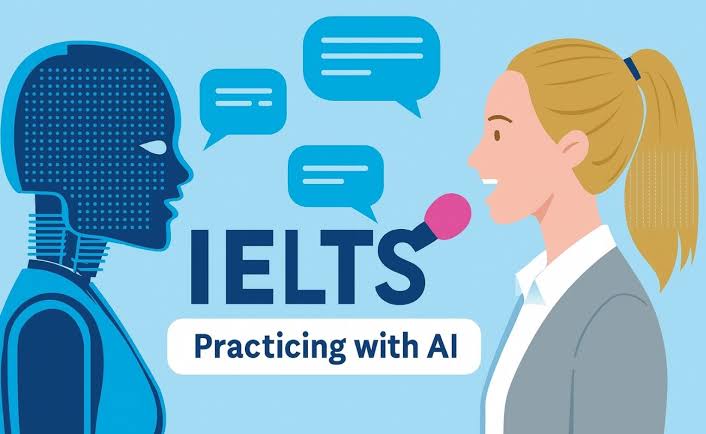
Want to achieve IELTS Speaking Band 7.0 without paying for a tutor every day? Artificial intelligence can help you practise speaking questions, improve vocabulary, identify grammar mistakes and become more confident answering under time pressure.
The secret is not to memorise impressive answers or ask AI to give you a higher score. It is to practise realistic questions, speak spontaneously, analyse your weaknesses and repeat the process until your answers become clearer and more natural.
Quick answer: To work toward IELTS Speaking Band 7.0, use AI as a practice partner. Ask it to simulate the examiner, record your answers, request feedback on the four official assessment criteria, correct recurring errors and give you follow-up questions. Then practise the improved answer again without reading a script.
AI is useful because it makes frequent practice easier. However, AI-generated band estimates are not official scores, and automated speech analysis may miss important details. Use the official IELTS assessment criteria as your reference and consider feedback from a qualified teacher if you need a more reliable evaluation.
What Does IELTS Speaking Band 7.0 Mean?
Band 7 is commonly described as a good level of English proficiency. In the Speaking test, candidates are expected to communicate at length, organise their ideas effectively, use a range of vocabulary and grammatical structures, and remain understandable with generally effective pronunciation.
Band 7 does not mean speaking perfect English. You can make occasional mistakes and still perform well. What matters is how effectively you communicate overall and how your performance matches the assessment criteria.
| Assessment criterion | What to work toward for Band 7 | How AI can help |
|---|---|---|
| Fluency and Coherence | Speak at length, organise ideas clearly and use linking language naturally. | Identify long pauses, unclear organisation, repetition and answers that lack development. |
| Lexical Resource | Use a flexible range of vocabulary, paraphrase when needed and express precise meanings. | Suggest natural alternatives, explain collocations and identify repeated or incorrectly used words. |
| Grammatical Range and Accuracy | Use a variety of sentence structures with a good level of control. | Highlight recurring grammar errors and provide examples of more accurate sentences. |
| Pronunciation | Make speech easy to understand, with effective word stress, rhythm and intonation. | Help analyse recordings where audio tools are available, while recognising the limits of automated evaluation. |
These four criteria contribute equally to the IELTS Speaking assessment. Improving only vocabulary will not compensate for persistent problems with fluency, grammar or pronunciation.
For the official description of the scoring criteria, consult the IELTS official website and its Speaking band descriptors.
Why Use AI to Prepare for IELTS Speaking?
Traditional preparation can involve books, practice tests, classes and tutoring. AI adds an opportunity to practise questions interactively whenever you have time.
Practise whenever you want
You can ask AI to simulate an examiner before work, during a break or in the evening. Regular practice becomes easier when you do not need to schedule every session with another person.
Get personalised follow-up questions
Instead of repeating the same sample answers, ask AI to challenge your ideas and request explanations, examples or comparisons similar to the discussion in Speaking Part 3.
Identify repeated mistakes
AI can analyse a transcript and flag issues such as incorrect verb tenses, limited linking phrases, repeated vocabulary or sentences that are difficult to follow.
Build speaking confidence
Practising privately can make it easier to experiment with answers and learn from mistakes before speaking with a teacher or examiner.
However, AI feedback is only as useful as the practice you give it. If you type polished answers instead of speaking spontaneously, you may improve your writing while leaving your actual speaking skills underdeveloped.
Best AI Tools for IELTS Speaking Practice
1. ChatGPT: Best for Interactive Mock Interviews
ChatGPT can act as an IELTS examiner, ask questions one at a time, respond to your spoken answers when voice input is available, and help you review transcripts.
It is particularly useful for practising all three parts of the Speaking test. You can ask for follow-up questions, vocabulary explanations, grammar corrections and alternative ways to express your ideas.
Best use: Run realistic mock interviews and request criterion-by-criterion feedback after finishing a complete section.
2. ELSA Speak: Best for Pronunciation Practice
ELSA Speak focuses on pronunciation and spoken English. Its speech-feedback features can help you practise sounds and notice areas that may need attention.
Best use: Supplement your mock interviews with targeted pronunciation practice. Remember that pronunciation is about intelligibility and effective speech, not eliminating every trace of an accent.
3. Grammarly: Best for Grammar Awareness
Grammarly can help you understand grammar and sentence-level issues in written transcripts. This can be useful after you transcribe your own speaking response.
Best use: Review the sentences you said aloud, identify recurring errors and practise saying corrected versions naturally. Do not treat a writing assistant as a complete speaking assessor.
4. Speech-to-Text Tools: Best for Reviewing Your Answers
Speech recognition can turn your recording into text, making repeated words, incomplete sentences and grammar problems easier to spot. You can use an available transcription feature or another speech-to-text tool.
Best use: Compare what you intended to say with what appears in the transcript. Be aware that transcription errors may come from the software rather than your pronunciation.
The Best AI Prompt for IELTS Speaking Band 7
A vague request such as “Help me improve my IELTS” often produces generic advice. A more effective prompt defines the examiner’s role, the test format, how you should be questioned and what feedback you want after answering.
Copy this master prompt into your AI assistant:
Act as a strict but supportive IELTS Speaking practice partner.

My target is IELTS Speaking Band 7.0. Simulate the real Speaking test as closely as practical.

Rules:
1. Ask me one question at a time.
2. Start with Part 1, then offer a Part 2 cue card, and then ask Part 3 discussion questions.
3. Wait for my spoken answer before asking the next question.
4. Do not give me a model answer before I attempt the question.
5. Encourage spontaneous answers rather than memorised scripts.
6. After the practice section, analyse my performance using the four IELTS Speaking criteria:
   - Fluency and Coherence
   - Lexical Resource
   - Grammatical Range and Accuracy
   - Pronunciation, if enough audio is available to assess it.
7. Explain my three most important weaknesses and give examples from my answers.
8. Correct errors without rewriting my answers into unnatural or overly advanced English.
9. Suggest natural vocabulary and collocations that fit my meaning.
10. Give me a realistic improvement plan for my next practice session.

Clearly label any band estimate as unofficial. Do not guarantee a score or pretend to be an official IELTS examiner.

Begin with the first Part 1 question.
For the most useful results, use a voice interaction that allows you to speak your answers. If you use text chat, speak aloud first, record yourself and then provide an accurate transcript for analysis. A typed answer alone cannot reveal all aspects of your speaking performance.
How to Use AI for IELTS Speaking Part 1
Part 1 contains familiar questions about topics such as work, studies, hobbies, home, food, transport and daily routines. Your goal is to answer naturally, provide enough information and avoid turning every question into a long speech.
Example question
Question: What do you enjoy doing in your free time?
Practice prompt:
Ask me 10 IELTS Speaking Part 1 questions about hobbies and free time, one at a time.

Wait for each answer. After I finish all 10 questions, identify:
- Answers that were too short or too long.
- Repeated vocabulary.
- Grammar mistakes.
- Places where I could add a natural reason or example.

Do not give model answers until I have completed my own responses.
How to improve your answers
A useful Part 1 answer often contains a direct response and one or two supporting details. You do not need an elaborate story for every question.
Too short
“Yes, I do. I like music.”
This answers the question but gives the examiner very little to work with.
More developed
“Yes, definitely. I listen to music almost every evening because it helps me unwind after a busy day. I usually choose something relaxing when I want to switch off.”
This adds a reason and a relevant detail without becoming unnecessarily complicated.
The second example is not a guaranteed Band 7 answer. Your score depends on your overall performance across the four criteria, not on whether you use a particular template.
How to Use AI for IELTS Speaking Part 2
Part 2 requires you to speak on a topic for one to two minutes after a preparation period. The challenge is developing ideas, maintaining a clear structure and speaking for long enough without simply memorising sentences.
Example cue card
Describe a skill you would like to learn.
- What the skill is.
- Why you want to learn it.
- How you would learn it.
- Explain how this skill could benefit you.
AI practice prompt for Part 2
Give me one IELTS Speaking Part 2 cue card.

Let me prepare for one minute, then ask me to speak for up to two minutes. If your interface supports voice interaction, wait while I answer aloud. Otherwise, let me record my response separately and submit the transcript.

After I finish:
1. Check whether I addressed all the bullet points.
2. Identify gaps in the story or explanation.
3. Highlight repetition, grammar mistakes and unnatural expressions.
4. Suggest a clearer sequence for my ideas.
5. Give me three follow-up practice tasks.

Do not ask me to memorise a complete model answer.
Use a flexible structure, not a memorised script
You can organise a Part 2 answer using a simple sequence:
- Introduce the topic: State what you are describing.
- Give the background: Explain when, where or how it became relevant.
- Develop the details: Add examples, reasons or a brief personal experience.
- Finish with reflection: Explain why it matters to you or what you learned.
This is a planning aid, not an official required structure. Adapt it to the cue card and use your own experiences. A natural, well-developed answer is more valuable than a polished response that sounds memorised.
How to Use AI for IELTS Speaking Part 3
Part 3 explores broader and more abstract issues connected to the Part 2 topic. You may be asked to compare the past and present, discuss social trends, evaluate advantages and disadvantages or speculate about the future.
Example question
Question: Why do some people find it difficult to learn new skills as they get older?
Rather than responding with one sentence, practise explaining your opinion and supporting it with a reason or example. You can also acknowledge that different people have different circumstances.
Part 3 practice prompt:
Act as an IELTS Speaking Part 3 examiner.

Ask me six discussion questions about education, technology and lifelong learning, one at a time.

Use questions that require me to:
- Explain an opinion.
- Compare different situations.
- Discuss advantages and disadvantages.
- Consider social changes.
- Predict possible future developments.

After my answers, identify where I need clearer reasoning, more precise vocabulary or better examples. Help me practise explaining ideas naturally rather than using memorised essay phrases.
Develop answers with reasons and examples
A flexible way to organise a Part 3 answer is:
- Point: State your main opinion.
- Reason: Explain why you think that.
- Example: Illustrate the idea with a relevant example.
- Qualification: If appropriate, mention an exception or alternative perspective.
You do not need to follow this structure mechanically. The aim is to make your reasoning clear and give the examiner enough language to assess your ability.
Use This AI Practice Generator
Choose a Speaking part and a topic to generate a practice prompt. You can then copy it into your preferred AI assistant and answer the questions aloud.
Your personalised AI prompt
How to Get Useful Feedback From AI
One of the biggest mistakes candidates make is asking AI to score an answer and then moving on. A score estimate is much less useful than specific feedback that tells you what to practise next.
Ask for examples from your own answer
Instead of asking “Is my vocabulary good?”, ask AI to identify repeated words, unnatural collocations or vague expressions from your actual response. Request a short explanation and practise using improved alternatives in new sentences.
Focus on three priorities at a time
Trying to correct every mistake during one session can overwhelm you. Ask AI to select the three issues that most affect clarity or performance. Work on those first, then reassess after a few sessions.
Separate content feedback from pronunciation feedback
A transcript can reveal grammar, vocabulary and organisation, but it cannot reliably show how you sounded. Pronunciation feedback requires audio and a tool capable of analysing speech. Even then, automated feedback should be treated cautiously.
Repeat the same task without reading corrections
After receiving feedback, put the model answer aside and try the question again. This tests whether you can use the correction spontaneously. If you only read a polished answer, you may recognise the improvement without being able to reproduce it while speaking.
How to Track Your Progress Toward Band 7
Keep a record of your practice so that you can see whether the same problems appear less frequently over time. Do not depend on a single AI-generated score to measure progress.
| Skill | What to record | Practice target |
|---|---|---|
| Fluency | Long pauses, repeated fillers and unfinished ideas | Deliver clearer, more connected answers without rushing |
| Vocabulary | Repeated words and inaccurate expressions | Use more precise language and natural collocations |
| Grammar | Recurring tense, agreement and sentence-structure errors | Use a range of structures with improved accuracy |
| Pronunciation | Words that listeners struggle to understand | Improve intelligibility, word stress and sentence rhythm |
| Task development | Questions answered incompletely or without support | Explain ideas clearly and add relevant details |
A 30-Day AI Study Plan for IELTS Speaking Band 7
This plan assumes that you can study for approximately 30–45 minutes a day. Adapt the workload to your current level, available time and exam date. Thirty days can help you build better habits, but it does not guarantee Band 7.
Identify your weaknesses
- Complete a baseline mock Speaking test.
- Record answers to familiar Part 1 questions.
- Practise one Part 2 cue card.
- Review grammar and repeated vocabulary.
- Choose three priority weaknesses.
Improve fluency and vocabulary
- Practise answering without scripts.
- Learn useful collocations in context.
- Use reasons and examples to develop ideas.
- Repeat corrected answers aloud.
- Review pauses and unnecessary repetition.
Strengthen grammar and pronunciation
- Practise accurate complex sentences.
- Correct recurring tense and agreement errors.
- Work on word stress and clear speech.
- Record and compare selected answers.
- Practise challenging Part 3 questions.
Simulate the real test
- Complete full mock Speaking tests.
- Practise with unfamiliar questions.
- Use realistic timing and no prepared scripts.
- Review the same four assessment criteria.
- Repeat weak sections and track progress.
Daily routine example
| Time | Activity |
|---|---|
| 5 minutes | Review mistakes from your previous session. |
| 10 minutes | Answer new questions aloud without reading a script. |
| 10 minutes | Review the transcript or audio and request targeted AI feedback. |
| 10 minutes | Repeat answers, applying corrections naturally. |
| 5 minutes | Record your three priorities for the next practice session. |
Common Mistakes That Can Hold Back Your IELTS Speaking Score
- Memorising complete answers: Prepared scripts may sound unnatural and fail to answer the actual question.
- Using complicated words incorrectly: Precise, natural vocabulary is more useful than impressive words that do not fit the meaning.
- Speaking too quickly: Speed does not equal fluency. Focus on connected, understandable speech.
- Giving one-sentence answers to every question: Develop your ideas when appropriate, especially in discussion questions.
- Ignoring grammar because communication is understandable: Persistent errors can affect the grammar criterion even when the general meaning is clear.
- Trying to eliminate your accent: The goal is intelligibility and effective pronunciation, not sounding exactly like a native speaker.
- Trusting every AI score: An automated estimate may be inconsistent or inaccurate. Use the feedback to identify patterns rather than treating it as an official result.
- Practising only familiar topics: You need to handle unfamiliar questions and respond spontaneously.
IELTS Speaking Band 7 Practice Checklist
Use this checklist after each mock interview. It is a self-review tool, not an official scoring system.
Progress: 0 of 8 practice habits checked.
Frequently Asked Questions
Can AI help me get Band 7 in IELTS Speaking?
AI can help you practise questions, review transcripts, identify grammar patterns and develop answers. However, it cannot guarantee a Band 7 result. Your actual score depends on your performance in the test and how it meets the official assessment criteria.
Can ChatGPT score my IELTS Speaking test?
ChatGPT can provide feedback and an unofficial estimate based on the answers or audio available to it. The estimate may not match an official examiner’s score. Ask for specific evidence and corrections rather than relying on a single number.
How many hours should I practise IELTS Speaking each day?
A consistent 30–45-minute session is a practical starting point for many learners. The ideal amount depends on your current level, weaknesses and exam date. Regular speaking, reviewing mistakes and repeating answers are more useful than passive study alone.
Is AI better than an IELTS tutor?
They offer different benefits. AI makes frequent, flexible practice possible, while an experienced tutor can provide human judgement, personalised instruction and a more nuanced assessment. Combining AI practice with occasional expert feedback can be useful if your budget allows.
Should I memorise Band 7 sample answers?
No. Sample answers can help you understand how to develop ideas and use vocabulary, but memorising complete responses is risky. Practise organising your thoughts and expressing them naturally in your own words.
Can AI improve my IELTS pronunciation?
AI tools with audio capabilities can help you practise and may identify some pronunciation issues. However, automated feedback is not always accurate. Combine it with careful listening, recording yourself and, when possible, feedback from a qualified teacher.
How long does it take to reach IELTS Speaking Band 7?
There is no universal timeline. A learner already near Band 6.5 may need a different amount of practice from someone who struggles with basic grammar or fluency. Take a baseline practice test, identify your weaknesses and measure progress over several weeks.
What are the four IELTS Speaking assessment criteria?
IELTS Speaking is assessed on Fluency and Coherence, Lexical Resource, Grammatical Range and Accuracy, and Pronunciation. Each criterion contributes equally to the Speaking score.
Final Verdict: Use AI to Practise Smarter, Not to Memorise Answers
Getting IELTS Speaking Band 7.0 requires more than learning advanced vocabulary. You need to express ideas clearly, develop answers naturally, use grammar with good control and make your speech easy to understand.
Use ChatGPT or another conversational AI tool to simulate the examiner, practise all three Speaking parts and review your recurring mistakes. Record yourself, work on a small number of weaknesses at a time and repeat answers without reading prepared scripts.
Most importantly, treat AI feedback as a learning aid rather than an official score. Combine frequent practice with the official IELTS criteria—and, if possible, feedback from a qualified teacher—to build a more reliable path toward your target band.
Official reference: IELTS — test information and preparation resources.
Editorial note: This guide is for educational purposes. AI-generated band estimates are unofficial and should not be interpreted as an IELTS result or guarantee of admission.